


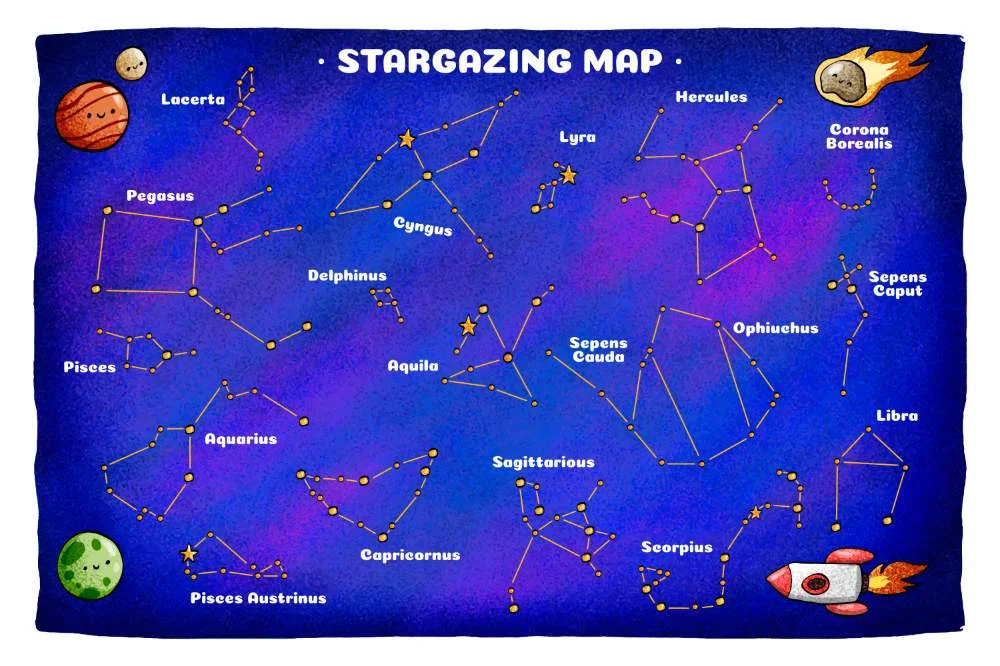
The names we use to describe the lights in the night sky are as varied and fascinating as the celestial bodies themselves. From "Arcalis," which reflects the name of a peak in Andorra, to the more familiar "Big Dipper," each name has its unique origin. However, tracing the roots of these names can sometimes be challenging.
Nevertheless, you can discover these names if you examine the history of their identification system. Learning why these systems exist and their issues can also help you understand how astronomers have decided to use these specific names.
In this blog, we’ll explore the names of stars and how they received them.
The Most Popular Stars Names in The Sky
The star and constellation names have been passed down through cultures, mythologies and centuries of human curiosity. From ancient legends to modern science, every star has a story to tell.
If you’re searching for a name that’s truly out of this world, why not draw inspiration from the stars? Here are some of the most celestial-inspired star name options for your little one:
Star Names for Boys:
- Alzir – A peaceful name meaning "sensitive and kind."
- Caelum – Ancient word meaning "stars in heaven."
- Canis – Name of a constellation; symbolizes individuality and confidence.
- Dara – It means "star" in Turkish. In the Old Testament, it means "pearl of wisdom."
- Felis – Latin origin; means "lucky."
- Gunay – Turkish origin; means "sun moon."
- Hesperos – Ancient Greek; means "evening star."
- Izar – Southern European origin; translates to "star" in Basque.
- Leo – Zodiac sign; associated with bravery and strength.
- Mehr – Persian origin; means "sun" and "friendship."
- Namid – Native American origin; means "star dancer."
- Pavo – A constellation in the southern sky; means "small."
- Rasalas – Arabic origin; means "the northern star of the lion's head."
- Solaris – Latin origin; means "of the sun."
- Vesper – Latin origin; means "evening star."
- Zenith – English origin; means "the highest point."
Star Names for Girls
- Alula – Arabic origin; means "first leap."
- Bellatrix – Latin origin; means "female warrior."
- Calytrix – Latin origin; means "star flower."
- Delphinus – Derived from the scout of the Greek god, Poseidon.
- Electra – Greek origin; means "amber, shining."
- Helene – Greek origin; means "torch, beautiful."
- Lyra – A constellation; also means "brave" in Nordic.
- Maia – Greek origin; means "mother."
- Meissa – Brightest star in Orion; marks the head of the hunter.
- Miram – Hebrew origin; means "drop of the sea."
- Najima – Arabic origin; means "star in the sky."
- Nashia – Arabic origin; means "youthful, growing."
- Phoebe – Greek origin; means "radiant."
- Realta – Celtic origin; means "star."
- Realtin – Gaelic origin; means "little star."
- Roxanne – Kurdish origin; means "dawn" or "bright star."
- Sirius – Greek origin; means "glowing" and is the brightest star in the sky.
- Solara – Latin origin; means "of the sun."
- Stella – Latin origin; means "star."
- Tara – Sanskrit origin; means "star" and also refers to a goddess.
- Vega – A bright star in the Lyra constellation.
- Vespera – Latin origin; means "evening star."
- Zaria – Slavic origin; means "sunrise," often associated with a star.
How a Star is Named?
Stars can have multiple names. In fact, you can even ‘buy’ a star and name it. However, no nation will acknowledge such a name. Instead, astronomers have agreed upon naming systems developed to collect information about the night sky.
In particular, there are the following systems:
1. Based on Brightness
Though there are just below 5,000 stars you can see without a telescope, only the brightest ones have gained names across cultures. The brightest stars have had names since the bronze age. For example, there’s Sirius which is the brightest star after the Sun. Its name originates from Greek and means ‘glowing’.
Furthermore, some books collecting star names used this system as well such as John Bayer’s 1603 novel: Uranometria. In this book, Bayer named stars both by brightness and the constellation they’re in such as Alpha Cygni and Beta Cygni.
However, the brightness of a star isn’t constant. Stars such as Betelgeuse can naturally dim across a day or years. Moreover, light pollution, your eyesight, the quality of your equipment, the proximity of the star, and gas and dust in space can all affect how bright we perceive them to be.
2. Based on Ancient Catalogs
Another common way to name stars relies on the catalogs that have remained in good enough condition for modern astronomers to study. In particular, there are Ancient Greek, Chinese, and Arabic catalogs that collected these names. The names often refer to local myths and religions. You might even still use some of these stars’ names. For example, the star Acrab from the Scorpius constellation has Arabic roots. In Arabic, ‘al-aqrab’ means ‘the scorpion’.
However, different catalogs could have names for the same star. Moreover, these catalogs didn’t have precise coordinates as is possible in the modern day. Therefore, there could be confusion about which star a name refers to.
3. Based on Alphanumeric Designation
The names of stars in the sky can also have numbers. Since there are millions of stars, it’s only reasonable that these harder-to-see stars receive partially numeric names. These names indicate where the star is in the sky and the source from which you’ve found this name, among other details. To exemplify, the alphanumeric designation for Aiolos, a star in the Carina constellation is HD 95086.
4. Based on the International Astronomical Union
Lastly, the internationally recognized organization International Astronomical Union names celestial bodies. So far, they’ve named over 400 stars through their Working Group on Star Names.
Their system focuses on cultural diversity. The names they have recognized and created come from a variety of cultures outside of the normative Greek and Latin. For instance, in 2019 this union accepted the name ‘Amansinaya’ for the Crate constellation star. This name comes from the God of the Ocean and Protector of Fishermen in Tagalog mythology: Aman Sinaya.
The Origin of Constellations
When it comes to constellations, their first names come from ancient cultures. The zodiac constellations are over 2400 years old and there’s evidence it was popular in Babylonian astronomy.
However, the International Astronomical Union now recognizes 88 of them. This collection of constellations has Latin names to keep the theme of the original constellation names which mostly originated in Europe. In addition, it recognizes the zodiacs and takes into account the rest of the night sky which previously didn’t have constellations.
The Names of Stars and Constellations

Now that you understand how these celestial bodies gained their names, let’s explore a few constellations and their stars.
Cassiopeia Constellation
Named after a queen in a Greek myth, this constellation has 5 bright stars in the W shape of her reclining body. The names of the stars are:
1. Segin: This name refers to an asterism it overlaps.
2. Ruchbah: In Arabic, this star’s name means knee.
3. Tsih: This star represents a whip from Chinese mythology.
4. Schedar: In Arabic, the name refers to the word ‘breast’.
5. Caph: This star also has an Arabic origin with the meaning ‘palm’.
Cygnus Constellation
Cygnus is a swan-shaped constellation you can gaze upon in the summer. This bird constellation appears to fly over the Milky Way and has the following stars:
1. Albireo: It’s at the head of the bird.
2. Deneb: This star marks the tail of the swan.
3. Fawaris: It’s the point of one of the wings.
4. Al Jannah: It’s the tip of the other wing.
5. Sadr: At the center of the constellation, there’s the star Sadr.
In particular, Deneb comes from the Arabic ‘danab ad-dajāja’ which means hen’s tail.
Orion Constellation
The Orion constellation depicts the hunter from Greek mythology. One of its most striking asterisms is Orion’s Belt which contains 3 stars:
1. Alnitak: This star is on the left side of the belt and refers to ‘girdle’ in Arabic.
2. Alnilam: This star is in the middle of the belt and the meaning of the star’s name is the Arabic word for string.
3. Mintaka: Derived from the Arabic word for belt, this star is on the right side of the asterism.
Leo Constellation
Leo is a spring constellation which you can identify by its inverted question mark asterism. This pattern of stars includes:
1. Regulus: It’s the brightest star in the pattern. Its name comes from the Latin for ‘little king’.
2. Adhafera: Meaning ‘braid’ in Arabic, this name refers to the lion’s mane of the constellation.
3. Algieba: This star’s name refers to the constellation ‘forehead’ in Arabic.
Conclusion
Now you know both the origin and the names of stars and the constellations they belong to. While you can also name a star by buying one, their true names originate from cultures and research by astronomers since before the bronze age. These names tell stories of myths of different cultures. However, when it comes to the dimmer stars, they may be names that refer to their place in time and their discovery. If you desire to study the stars, you can explore them using any of these different lenses, starting with the four constellations listed above.
FAQs
Are there any names of stars in the sky that represent strength or bravery?
Names like Leo, Orion, and Rigel are often associated with bravery and strength due to their mythological or stellar characteristics.
Are there any star names that are tied to famous constellations?
Many star names are deeply tied to famous constellations. For example, Betelgeuse is a prominent star in the Orion constellation, and Castor and Pollux are the twin stars of the Gemini constellation. These names help astronomers and stargazers identify and navigate the night sky.
Are there any star names that are suitable for both boys and girls?
Many star names are unisex and can be used for both boys and girls. Names like Nova, Lyra, and Orion are popular choices for both genders. These names reflect the beauty of the night sky and have universal appeal.
Ready to capture your special moment?
Create Your Star Map →