


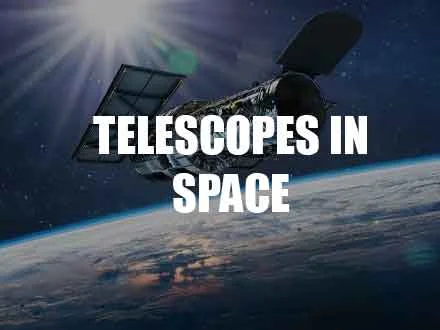
A space telescope is a telescope that is placed in outer space to observe celestial objects such as stars, galaxies, and planets. Because it is in space, a space telescope can capture images and data without the distortion caused by the Earth's atmosphere, which can be especially beneficial for observing infrared and ultraviolet light. This article discusses some of the world's most famous telescopes and the missions they were developed for.
You might always wonder what exists beyond the stars. Looking up at the night sky brings curiosity but our eyes cannot see very far. Light pollution, clouds, and distance make it hard to explore space from Earth.
To solve this problem, scientists created a tool called a telescope. It helps us see things that are far away in space. Over time, these tools have become more powerful and more advanced. Some telescopes now orbit above the Earth. These space telescopes do not have to deal with the atmosphere so that they can give us much clearer views.
Let us explore some of the most important space telescopes and learn how they help us understand the universe.
XMM-Newton (X-ray Multi-Mirror Mission)
The XMM-Newton telescope was launched in 1999 by the European Space Agency. It is designed to look at objects that give off very high-energy light, called X-rays. These X-rays often come from places like black holes or hot gases floating in space.
This telescope has three powerful mirrors and a special camera that helps it take clear pictures of distant space. It can watch objects for a long time without stopping. This makes it very good at capturing rare and energetic events in space, such as explosions or star deaths.
Chandra X-ray Observatory
The Chandra X-ray Observatory also launched in 1999. It is part of a group of important space tools called the Great Observatories. This telescope was named after a scientist named Subrahmanyan Chandrasekhar, who won a Nobel Prize for his work.
Chandra is very good at finding weak X-ray signals. These signals come from places like black holes and the remains of stars that have exploded. The telescope helps scientists see things they cannot see with normal light. This includes things like the edges of galaxies and areas filled with powerful radiation.
Spitzer Space Telescope
The Spitzer Space Telescope was launched in 2003 by NASA as the last part of the Great Observatories Program. This telescope explores the cool side of space, including young stars and dust clouds, by detecting infrared radiation.
The Spitzer Space Telescope has an 85 cm mirror that is relatively small but has valuable characteristics. It explores the faint heat signals that assist astronauts in witnessing various space events, including the birth of new stars and the center of the galaxies.
Herschel Space Observatory
Herschel Space Observatory was operated by the European Space Agency (ESA) in 2009. This telescope is distinguished from others by its largest mirror, measuring 3.5 meters. This is used to explore the mid-infrared light to far-infrared light and the cool objects. The primary purpose of this telescope is to understand the formation of stars and galaxies.
Its sensitive instruments also offered a glimpse into the early stages of planetary system formation and even discovered water vapor in faraway parts of the Milky Way.
The Hubble Telescope (HST)
The Hubble Space Telescope (HST) is probably the most well known out of all the famous telescopes, it was launched into low Earth orbit in 1990 and remains in operation. It was named after the American astronomer Edwin Hubble. The HST is a collaboration between NASA and the European Space Agency (ESA). Its primary mission is to study the universe in the electromagnetic spectrum's visible, ultraviolet, and infrared regions. The telescope is known for its high-resolution images and has made many important discoveries in astronomy, including determining the universe's rate of expansion.
The Kelper Space Telescope
The Kepler Space Telescope, also known as Kepler Observatory, was a space-borne telescope launched by NASA in March 2009. Its mission was to survey a portion of our region of the Milky Way galaxy to discover Earth-size exoplanets in or near habitable zones and estimate how many of the billions of stars in our galaxy have such planets. It was designed to detect Earth-size and smaller planets in or near habitable zones around stars similar to the Sun, and it was retired in 2018. The data collected by Kepler has been instrumental in discovering thousands of exoplanets, including many similar in size and composition to Earth.
The eROSITA Space Telescope
eROSITA (Extended Roentgen Survey with an Imaging Telescope Array) is a space telescope designed to survey the entire sky in X-rays. It was launched in 2019 as part of the Spectrum-Roentgen-Gamma (SRG) mission, a collaboration between the Russian Space Research Institute (IKI) and the Max Planck Institute for Extraterrestrial Physics (MPE) in Germany. eROSITA's primary scientific goal is to study the universe's large-scale structure and galaxy clusters' properties, as well as to search for distant, luminous X-ray sources such as active galactic nuclei and supermassive black holes. The telescope is expected to produce a detailed map of the sky in X-rays, which will be used to study a wide range of astronomical phenomena.
The TESS Space Telescope
The Transiting Exoplanet Survey Satellite (TESS) is a space telescope launched in April 2018 by NASA to discover exoplanets (planets outside of our solar system) using the transit method. TESS observes large sections of the sky for 27 days at a time, searching for temporary drops in brightness caused by planets passing in front of their host stars. It is expected to discover thousands of exoplanets, including many that are small and in the habitable zones of their host stars where liquid water could exist. TESS will also provide follow-up observations for some of the exoplanets discovered by the Kepler space telescope, which launched in 2009 and focuses on smaller, more distant stars.
The Fermi Gamma-ray Space Telescope
The Fermi Gamma-ray Space Telescope (formerly GLAST) is a space telescope designed to study gamma rays, the highest energy form of light. Launched in 2008, it is a collaboration between NASA, the U.S. Department of Energy, and institutions in France, Italy, Japan, and Sweden. The telescope uses a large pair production detector to observe gamma rays in the energy range of 20 MeV to more than 300 GeV. It has made numerous discoveries: including the first gamma-ray pulsar; the discovery of gamma-ray bursts originating from outside the Milky Way; and the discovery of hundreds of gamma-ray sources.
The Chandra X-ray Observatory
The Chandra X-ray Observatory is a space telescope launched by NASA in 1999. It is designed to observe X-rays from high-energy sources such as galaxy clusters, black holes, and supernovae. The telescope is named after the Indian-American physicist Subrahmanyan Chandrasekhar. It is one of NASA's Great Observatories, along with the Hubble Space Telescope, the Spitzer Space Telescope, and the James Webb Space Telescope. The Chandra X-ray Observatory has made many important discoveries in the fields of astronomy and astrophysics.
The James Web Telescope
The James Webb Space Telescope (JWST) is a large, infrared-optimized space telescope launched in 2021. It is the successor to the Hubble Space Telescope and is considered the most powerful space telescope ever built. The JWST is equipped with a large primary mirror that is 6.5 meters (21.3 feet) in diameter, which is more than twice the size of the Hubble Space Telescope's primary mirror. It will be able to observe some of the most distant objects in the universe. And even study the formation and evolution of galaxies, stars, and planetary systems. The Space Telescope Science Institute and the European Space Astronomy Centre will operate JWST.
Summary
Many famous telescopes are currently in space. Some examples include:
- The Hubble Space Telescope was launched in 1990 and is still in operation. It is primarily used to observe distant objects in the universe, such as galaxies and quasars.
- The James Webb Space Telescope, launched in 2021, will study the infrared universe, from the first galaxies formed after the Big Bang to the formation of planetary systems capable of supporting life on nearby exoplanets, including potential biosignatures in their atmospheres.
- The Chandra X-ray Observatory was launched in 1999 and is used to observe X-ray emissions from high-energy objects such as black holes and supernovae.
- The Fermi Gamma-ray Space Telescope, which was launched in 2008 and is used for observing gamma-ray emissions from high-energy phenomena such as gamma-ray bursts and active galactic nuclei.
- The Kepler Space Telescope was launched in 2009 and is primarily used for studying exoplanets by the transit method.
- The TESS Space Telescope was launched in 2018 and is primarily used for studying exoplanets by the transit method.
- The eROSITA Space Telescope was launched in 2019 and is used for X-ray imaging of the sky.
In this article, we discussed just a few examples of the many telescopes that are currently in space. Why not go explore NASA's to learn more about the amazing things going on in space.
Or why not treat yourself to a high quality print of the images these famous telescopes have taken just here.
FAQ
What is the most famous telescope in space?
The Hubble Telescope is the most famous telescope due to its decade-long mission and ability to see different types of light, including visible light, ultraviolet, and infrared light. It helped astronauts gather deep space images and become the most valuable telescope.
What is the best telescope to see space?
The best type of telescope depends on the function you are looking for. For example, if you want to explore early galaxies, James Webb is the best choice. Similarly, the Hubble Space Telescope is used to capture sharp images, while Chandra is used to explore high-energy events, such as black holes.
What are the four great telescopes?
NASA’s Great Observatories include: Hubble (visible/UV/IR), Chandra (X-ray), Spitzer (infrared), and the Compton Gamma Ray Observatory (gamma rays).
What are the three space telescopes?
A core trio often cited are Hubble (optical/UV), Chandra (X-ray), and James Webb (infrared), each specializing in a different part of the electromagnetic spectrum.
Ready to capture your special moment?
Create Your Star Map →