


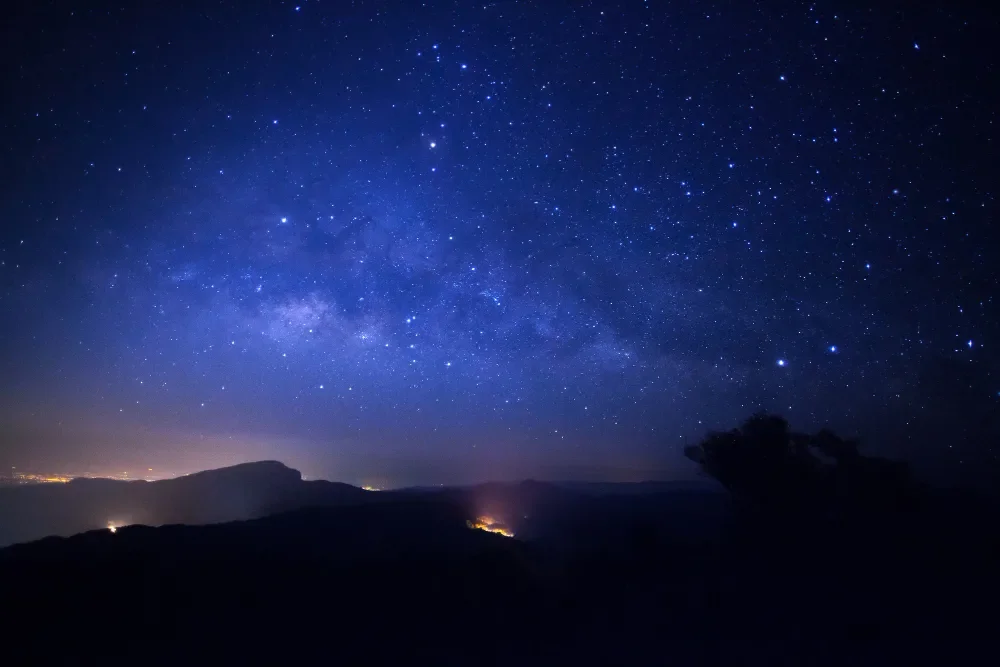
The night sky has a magical way of attracting us no matter where we are in life. It is quiet, constant, and vast. It may remind you of a night that is special to you. A quiet moment under the stars when you fell in love. The evening your child was born. Or a calm walk when everything just felt right.
What if you could keep that sky forever just as it looked at that exact moment?
You can. And the first step is learning how to read a star map.
This guide will walk you through that process, step by step, so the sky no longer feels distant. It starts to feel like home.
What Is a Star Map and Why Does It Matter?
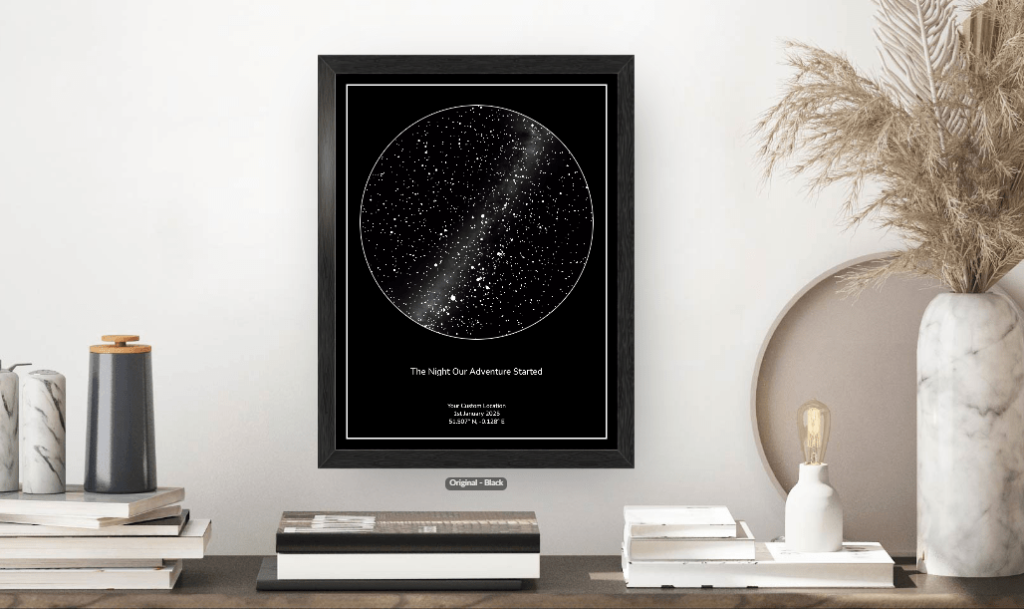
A star map captures the sky as it appears from a specific location at a precise moment. The arrangement of stars, their brightness, and their positions are all recorded with precision. These details reflect real astronomical data.
You can use one to find your way through tonight’s constellations or to hold on to a night that meant something deeply personal. The sky becomes a kind of time capsule, quietly holding a memory in place.
What You Will See on a Star Map
Reading a star map is like learning to decode a quiet, celestial language. Let us walk through what you will find on a star map:
Stars
Each little dot on the map represents a star. Some dots are bigger than others. It just means those stars shine brighter in the sky. It is a quiet yet smart way for nature to show just how much light each one brings from so far away.
Constellation Lines
You might notice some stars are connected by lines. These form familiar shapes, like Orion’s Belt or Cassiopeia’s curve. They give the sky some structure, like a story you can follow every time you look up.
Cardinal Directions
Around the edge of the map, you will find the cardinal directions, N, S, E, and W. These are there to help you line up with the real world. If you are facing east, simply turn the map so that “E” is facing you as well, and the chart will suddenly match the sky.
The Ecliptic Line
There is a soft curve that runs across the map. That curved line marks the path the Moon and planets follow through the night. It is your quiet guide for spotting Venus, Jupiter, or the Moon as it climbs and drifts across the stars.
The Milky Way
Some maps show a gentle streak stretching across the middle. That is the Milky Way, our galaxy, from the inside out. It reminds you that you are standing inside a world that is immensely huge and full of wonder.
Zenith and Horizon
Think of your map like a snapshot of the dome above your head. The center is the zenith which is directly overhead. The outer circle marks the horizon in every direction. Once you hold it up and line it with the real sky, the chart becomes a reflection of the night above you, just as you see it.
How Star Maps Work
Think of the sky as a giant globe stretched above you. The sky uses declination and right ascension just the way you use latitude and longitude on Earth.
- Declination (Dec): Just like latitude, it tells you how far north or south a star lies from the celestial equator.
- Right Ascension (RA): Like longitude, it is measured in hours, minutes, and seconds. It tells you how far along the sky a star is from the vernal equinox.
For instance, Sirius is the brightest star in our sky. It sits at RA 06h 45m and Dec -16°. This coordinate system ensures that your map is astronomically accurate, whether you are gazing from Manchester or Morocco.
How to Read Star Map in 5 Simple Steps
Once you have your star map in hand, the real magic begins. Here is how to bring the sky to life, one simple step at a time.
1. Begin with a Moment That Matters
Your map is tied quite literally to time. Start by choosing the date and location that is special to you. Maybe it was the night of your first meet-up, your child’s birth, or simply a quiet evening under the stars.
2. Step Outside and Look Up
Step into the open air and lift the map above your head. The sky is not flat. It curves above you like a giant dome. Align the “N” on your map with the direction of True North (a compass app can help if you are not sure). Now, the chart mirrors the heavens exactly as they appear above you.
3. Start with an Easy Constellation
Start by finding the brightest star patterns. Shapes like Orion’s Belt or the Big Dipper are easy to see, even with some city lights. Use them as your starting points. They will help your eyes get used to the sky and make it easier to find other stars nearby.
4. Follow the Stars
When you find a star or constellation you recognize, take your time and look around it. Use the lines on your map to guide your eyes from one star to the next. This slow “hopping” from star to star is a fun way to discover more in the sky—just like astronomers do when they search for dimmer sights like nebulae or galaxies. It is like taking a quiet little journey across the stars.
5. Use Soft Light and Take Your Time
Use a red flashlight or a red-light filter on your phone to read the map. This protects your night vision and lets your eyes stay tuned to the darkness. The longer you stay outside, the more stars you will see. Give your vision time, and the sky will slowly open up to you.
Star Map or App: Which One Brings the Sky Closer?
While phone apps have their place, they often overlook the emotional value that a physical star map holds. An app shows you what is above you. But a print like from Picture The Stars captures what was above you on your wedding night, the day of your child’s birth, or a cherished anniversary.
Phone apps are great for seeing what's in the sky right now, but they lack the emotional value that a printed star map carries. It shows the exact sky that was above you during a moment that mattered.
Here is a quick comparison between an app and a star map:
| Feature | App | Star Map Print |
|---|---|---|
| Real-time Sky View | Yes | No |
| Custom Moment Display | Limited | Yes (specific date, time, location) |
| Keepsake Value | None | High (emotional and decorative) |
| Scientific Accuracy | Varies | Verified via ESA star catalogues |
| Gift-Worthy | No | Absolutely |
Tips to Make Stargazing Even More Magical
- Pick a Clear, Moonless Night: The darker the sky, the more stars you will see.
- Dress Warmly and Bring Snacks: Stargazing can take time—make it cosy.
- Keep a Journal: Note what you find and how you feel. This builds connection.
- Share the Moment: Stargazing with someone special makes it unforgettable.
Your Story Is Written in the Stars
When you know how to read star charts, the night sky becomes a place filled with meaning. Every star, every shape, every quiet glow tells a story. The next time you step outside and look up, you will not just be stargazing. You will be remembering, reconnecting, and holding onto a piece of your own sky.
Picture The Stars offers you the chance to preserve that feeling forever. Their custom Star Maps and Moon Phase Prints capture the sky exactly as it appeared on your special date, from the alignment of constellations to the unique phase of the moon. For space lovers, the Deep Space Prints add a breathtaking cosmic touch to any wall.
These prints are more than simple gifts. They are deeply personal treasures, filled with meaning, memory, and made to be cherished for years to come. Create a print that captures your night sky, and let your story shine forever.
Ready to capture your special moment?
Create Your Star Map →