


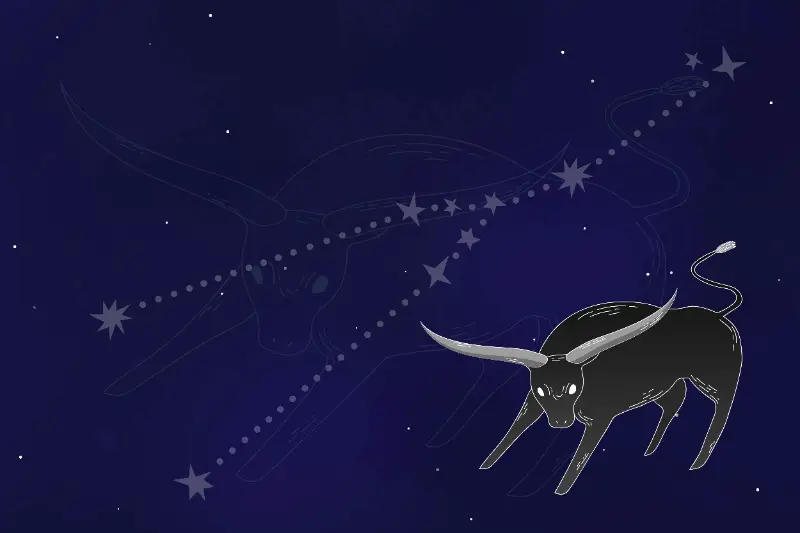
Whether you were born a Taurus or simply curious about this zodiac, you might wonder about the history behind this constellation. Taurus’ symbol, the bull, appears in myths across the Americas, Europe, and Africa. In addition, depictions of its constellation date back to 16,500 BC.
Since this constellation has been part of cultures for so long, you might then wonder if these myths have a common origin. However, even within a region, there can be multiple myths about this constellation.
In this blog, we’ll reveal the myths linked to this constellation. But first, let’s examine what this constellation is.
What Is the Taurus Constellation?
Taurus is a large, well-known constellation. You’ll find this collection of stars in winter and spring, along the path the sun takes when it crosses the sky. More specifically, it’s between the Aries and Gemini constellations. As a zodiac sign, you can draw it as a circle with two horns. However, its start shape appears more like tongs representing the horns, and legs.
Many ancient peoples such as the Zuni tribe of New Mexico used this constellation’s ‘Seed Stars’ also known as Pleiades to track their planting season. Moreover, in ancient Egypt, bulls symbolized fertility.
The stars of Taurus constellation include:
- Aldebaran: In Arabic, this star’s name means follower. It may be due to how it appears to follow after the Pleiades when it rises from the East.
- Elnath: This star’s name originates from the Arabic word for ‘the butting’ which refers to the bull’s horns.
- Pleiades: Known as the Seven Sisters, Seed Stars, and Messier 45, this group of stars are on the bull’s ‘back’.
- Hyades: These are two-star clusters that are close to Earth.
The Myths of the Bull Star Sign

This constellation has been a source of inspiration for thousands of years, pushing civilizations to draw it in the Lascaux caves nearly 19,000 years ago. The Taurus appears in myths across many different cultures from Greece to Egypt to Babylon.
Let’s delve deeper into the different myths around Taurs.
1. Zeus and the Bull
In Greek mythology, there are multiple origin stories of the constellation Taurus. In particular, there are two myths which include Zeus. In one myth, Zeus turns into a white bull to approach the Phenician Princess, Europa. He hid among the bulls in her father’s herd but his beauty made him stand out. Once she straddled him, he swam into the sea. In the constellation, Zeus then appears as a bull with his head and torso breaking the surface of the water.
Secondly, there’s the myth that Zeus turned Io into a heifer. Io was a nymph who was the mistress of Zeus. When he thought his wife, Hera, was about to discover their affair, Zeus transformed Io.
2. Bull of Heaven
Another myth about the Taurus star constellation comes from the epic of Gilgamesh. The story appears in an older Sumerian poem. In this Mesopotamian myth, Gilgamesh refuses the advances of the Goddess Ishtar/Inanna. In revenge, she acquires a bull which she uses to attempt to kill Gilgamesh. In the myth, the Taurus and Orion Hunter constellations depict the battle with Gilgamesh as the hunter. However, it’s Gilgamesh’s companion Endiku who defeats the bull.
3. Cretan Bull
Another Taurus constellation myth comes from ancient Greece: The Cretan Bull. In the Greek myth, Poseidon sends a bull to King Minos, expecting him to sacrifice it. However, the King refused to sacrifice it since it was an exceptional bull. Instead, he swapped it with a worse-quality bull which angered Poseidon. The Sea God cursed the King’s wife, Pasiphaë. The curse forced her to fall in love with the beast. Together, they had a child: The Minotaur.
This same Bull also appears in Heracles’ myth. In this story, Heracles must find the Cretan bull which was tearing through the fields of Crete. Though Heracles managed to capture the Bull and take it to Tiryns, it eventually escaped.
4. Apis the Bull God
In ancient Egypt, the constellation of Taurus has a link to Apis or Hapis, the bull God. This deity was a real, physical bull selected as the vessel of the God Osiris and was a symbol of fertility. The Apis would then act as a go-between for mortals and some of the more powerful Gods in the ancient Egyptian pantheon. Moreover, this bull would be part of sacrifices. When it died, Osiris’ spirit would transfer to the next bull.
Furthermore, the appearance of Apis strongly resembles the zodiac sign. It’s usually depicted with a circle between its horns. This circle is a sun-disk which was a symbol of Hathor, the mother of multiple Gods in the pantheon.
5. Cerus the Bull
Lastly, the Greek myth of Cerus has a tie to Taurus. Like with the Cretan bull, this myth is also about a destructive bull. However, in this myth, the Goddess of spring, Persephone, calms the bull. She then rides it and wherever they travel, flowers sprout.
In the myth, they travel together every spring and that’s why the flowers grow. In addition, since in the myth they’re on Earth, the constellation isn’t visible. When autumn approaches, Persephone returns to the underworld to be with her husband. Then, Cerus travels to the sky, waiting for Persephone’s return.
Recap
Now you know that there are many myths surrounding the Taurus constellation. From Mesapotenia to New Mexico, this constellation has had significant importance to ancient civilizations. In each civilization, it’s perceived as a bull but its meaning changes depending on the culture.
Among the Zuni tribe and in ancient Egypt, the Bull had a connection of fertility. Meanwhile, the Greeks perceived the bull as a sign of beauty, violence, and deceit. The aspect of violence also appears in the ancient Gilgamesh Epic, where the bull takes on an adversarial role. To better appreciate these diverse myths, you can stargaze in winter and spring to catch sight of this collection of stars.
Ready to capture your special moment?
Create Your Star Map →