



You designed a star map for your wedding date last spring, then another one for your anniversary this year. They look nearly identical. It is the most common question we get from customers.
A star map is a printed reconstruction of the exact night sky over one specific place, at one specific moment in time, calculated from real astronomical data. When two maps come out looking similar, it is not a mistake and it is not the software cutting corners. It is astronomy working the way astronomy works.
Star maps for different dates from the same place often look nearly identical because the stars themselves barely move on a human timescale. What changes night to night: the moon's phase and position, where the planets sit, which constellations are highest overhead. Those are the details that make each map unique.
How much does the night sky actually change from one night to the next?
Very little, on a human scale. And that is the whole point.
The stars are not planets. They are distant suns, many light-years away. Their positions relative to each other change so slowly that the constellations your great-great-grandparents saw are essentially the same ones you see tonight.
Here is a rough rule that helps: on our 40x50cm printed star map, 1 cm on the paper represents roughly 80 light-years if a star sits 1,000 light-years away. Over your entire lifetime, that star will have moved a fraction of a millimetre on the print.
The practical upshot: in ten years' time, the stars are essentially exactly where they are tonight. In ten hours' time though, the sky would look completely different, because the Earth has rotated underneath them.
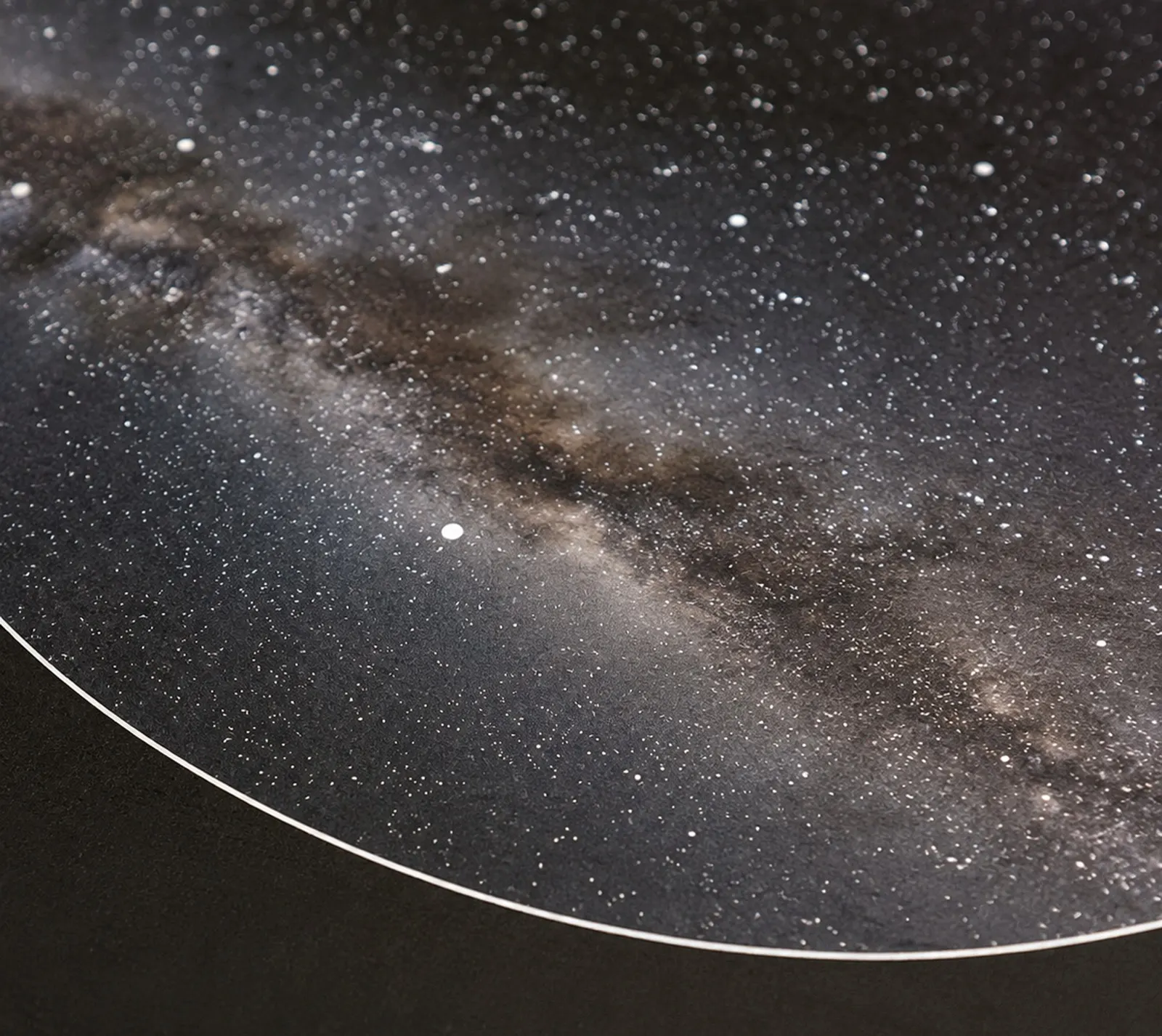
A close-up of the Milky Way band on one of our printed star maps. Every star position calculated from real astronomical data.
What actually makes each star map unique?
What changes night to night is not the stars themselves. It is which slice of the whole starry sky is visible from where you are standing at the exact hour you picked.
Four things shift the picture:
- Which constellations are visible. Orion might dominate the southern sky in one map and sit near the horizon (or be absent entirely) in another. Some constellations only appear in summer, others in winter.
- The moon's phase and position. A thin crescent low in the west looks completely different from a full moon high overhead. The moon cycles every 29 days, so no two star maps even a week apart have the same moon.
- Where the planets sit. Venus, Mars, Jupiter, and Saturn wander through the constellations. A wedding-night map with Venus prominent in the west will look strikingly different from a map three months later.
- Seasonal sky rotation. A July evening in the Northern Hemisphere shows almost completely different constellations from a January evening. The Milky Way rides high overhead in summer and much lower in winter.
Do two cities on the same date look identical?
Not exactly, but often more similar than most people expect.
If you are both in the Northern Hemisphere, say Manchester and Madrid, the stars overhead at midnight on the same date look broadly similar because you are both on roughly the same latitude band.
Move further apart though. Manchester versus Sydney on the same night is almost mirror opposites, because Sydney sees the Southern Hemisphere sky (Southern Cross, Alpha Centauri, the Magellanic Clouds) that you will never see from the UK.
Your GPS coordinates matter. But for two neighbouring UK cities on the same evening, the difference is small. That is not a flaw, that is geography.
How does Picture the Stars render to the exact minute?
Behind the scenes: we take your chosen date, time, and location. We look up star positions from the ESA Hipparcos catalogue, over 100,000 stars catalogued by professional astronomers. We calculate which stars are above the horizon from your specific coordinates at your specific moment. We plot the moon's phase and position from NASA astronomical data. We render the planet positions based on their orbital mechanics.
Every print is calculated to the minute you entered. Change the time by an hour and the sky rotates about 15 degrees, visible on the print if you know where to look. Change it by six hours and it is a different sky entirely.
A note on what we choose to show. We filter to the brightest stars, roughly magnitude 6 and brighter, which is the naked-eye limit under a dark sky. If we plotted every catalogued star, the print would be a solid grey wash. So we favour the biggest and the brightest, the same stars you would actually see standing under the real sky.
Learn more about the science behind our star maps.
How can you test the accuracy yourself in 60 seconds?
Download the free planetarium app Stellarium (or open Stellarium.org in a browser). Set the same date, time, and location you used for your Picture the Stars print. Compare what appears on your screen with what is on your print.
You will see the same constellations in the same positions, the same moon phase, the same planets. Because we are both pulling from the same real astronomical data sources.
That comparison is the honest test we point customers to when they ask "is this actually accurate?" The answer is yes, and you do not have to take our word for it.
If you want a star map that looks obviously different from another date, the fastest lever is the TIME field, not the date. Because Earth rotates 15 degrees every hour, shifting the time by a few hours dramatically changes the visible constellations. The time of birth, the exact moment of "I do", the minute your daughter arrived. Those specific times give you a sky that is genuinely one of one.
Frequently asked questions
Is my star map wrong if it looks like my friend's?
No. If you are both in the same country on similar dates, the underlying sky is genuinely similar. The differences show up in the moon phase, planet positions, and exact constellation placement. Look closer and you will spot them.
Why does it look like a generic poster?
Because most nights, from most places, share a familiar overall pattern of stars. That is what makes the night sky feel like the night sky. If it did not look somewhat generic, it would not be accurate.
Can I see the difference between two dates a week apart?
Yes, but subtly. The moon will be in a different phase and position. The planets will have shifted. Certain constellations will be rising or setting at different times. It is not dramatic, but it is genuinely there.
Does the location I choose really matter?
Yes. Two cities in different hemispheres show completely different skies. Two cities in the same country on the same night look similar but not identical, because the horizon line and specific star visibility differ.
What if my recipient compares two of my orders side by side?
They will see the same overall sky pattern, which is honest. That is what the sky looks like. The unique details, moon phase, planet positions, seasonal constellations, will be different. And the meaningful part is that you chose those specific dates for them.
Do you show planets on the star map?
Yes. Planets appear in their real positions on your chosen date. They move through the constellations over months, so their placement changes genuinely from map to map.
See the specific sky above your own moment
The similarity between two star maps is not a bug in the software or a shortcut we have taken. It is the universe behaving the way the universe behaves, slowly, on human timescales, with real detail in the moon, the planets, and the constellations if you look closer.
The meaningful part of a star map is not that it looks dramatically different from every other one. It is that it is the exact sky above the place and moment you chose. Every date matters because you picked it. The stars just quietly confirm it.
Prints from £21.99, with framing available. 285gsm museum-grade art cardstock, Canon Giclée printers. Made in our Failsworth Manchester workshop, free UK delivery, 4.7 stars on Trustpilot from 3,600+ reviews. Build a live preview here, takes about 30 seconds. No order required to test it.
See the specific sky above your own moment. Free live preview.
Build Your Star Map